The Harvey Labs Doctrine
Purpose
Harvey Labs exists to explore the intersection of intelligent systems, resilient infrastructure, autonomous operations, and human-centered engineering.
The objective is not merely to build technology.
The objective is to understand how complex systems behave when subjected to observation, pressure, failure, adaptation, and autonomy.
Every project, experiment, benchmark, and implementation contributes to a broader body of knowledge focused on practical intelligence and operational resilience.
Core Philosophy
Modern systems are becoming increasingly autonomous.
Infrastructure is evolving from static configurations toward adaptive environments.
Artificial intelligence is moving from isolated tools toward active participants within operational ecosystems.
As complexity increases, visibility becomes more valuable than control.
Understanding becomes more valuable than prediction.
Resilience becomes more valuable than optimization.
The lab exists to investigate these transitions through direct experimentation.
Research Pillars
Pillar I: Sovereign Intelligence
How capable can local intelligence become without dependence on external services?
Areas of exploration:
- Local LLM deployment
- Quantization strategies
- Resource-constrained AI
- Model benchmarking
- Hybrid neural architectures
- Distributed intelligence
- Multi-model orchestration
- Edge AI
Representative Projects:
- Local LLM Benchmark Series
- Sovereign Neural Brain
- Model Evaluation Matrix
- Specialized Expert Routing Systems
Primary Question:
How much intelligence can be achieved while maintaining complete ownership of data, infrastructure, and execution?
Pillar II: Observable Systems
Complex systems cannot be managed if they cannot be understood.
The laboratory focuses on exposing hidden system behaviors through visualization and telemetry.
Areas of exploration:
- Network telemetry
- Infrastructure visualization
- Event correlation
- Operational awareness
- Failure analysis
- Real-time state mapping
Representative Projects:
- Lab Visualizer
- Network Topology Mapping
- Event Correlation Engines
- Operational Dashboards
Primary Question:
What becomes visible when infrastructure is treated as a living system rather than a collection of devices?
Pillar III: Resilience Engineering
The true nature of a system is revealed during failure.
The lab intentionally introduces faults to observe adaptation, degradation, recovery, and emergent behavior.
Areas of exploration:
- Chaos engineering
- Network failure simulation
- Path congestion analysis
- Storage failures
- Routing instability
- Service degradation
- Recovery measurement
Representative Projects:
- Fault Injection Framework
- Network Chaos Testing
- Infrastructure Stress Laboratories
- Recovery Validation Suites
Primary Question:
How do systems behave when assumptions fail?
Pillar IV: Ambient Operations
Interfaces are becoming obsolete.
The future of operations may not be dashboards.
The future may be persistent intelligence integrated directly into the operating environment.
Areas of exploration:
- OS-level observability
- Context-aware agents
- Ambient intelligence
- Human-machine collaboration
- Persistent operational overlays
Representative Projects:
- The Forge
- System Overlay Architecture
- Autonomous Monitoring Agents
- Environmental Intelligence Frameworks
Primary Question:
What happens when operational awareness becomes part of the environment itself?
Pillar V: Distributed Cognition
Large monolithic systems are not the only path toward intelligence.
Complex behavior may emerge from specialized components working together.
Areas of exploration:
- Multi-agent systems
- Neural brain architectures
- Specialist model routing
- Cognitive decomposition
- Collaborative reasoning
Representative Projects:
- Sovereign Neural Brain
- Expert Routing Systems
- Agent Coordination Frameworks
- Cognitive Architecture Research
Primary Question:
Can intelligence emerge more effectively through cooperation than centralization?
Research Methodology
Every project follows the same progression.
Observe.
Model.
Visualize.
Stress.
Measure.
Refine.
Document.
The goal is not to validate assumptions.
The goal is to discover reality.
Documentation Standards
Each project should produce:
- Problem Definition
- System Design
- Implementation Notes
- Test Methodology
- Failure Analysis
- Performance Metrics
- Lessons Learned
- Future Research Directions
Every experiment becomes a permanent contribution to the laboratory knowledge base.
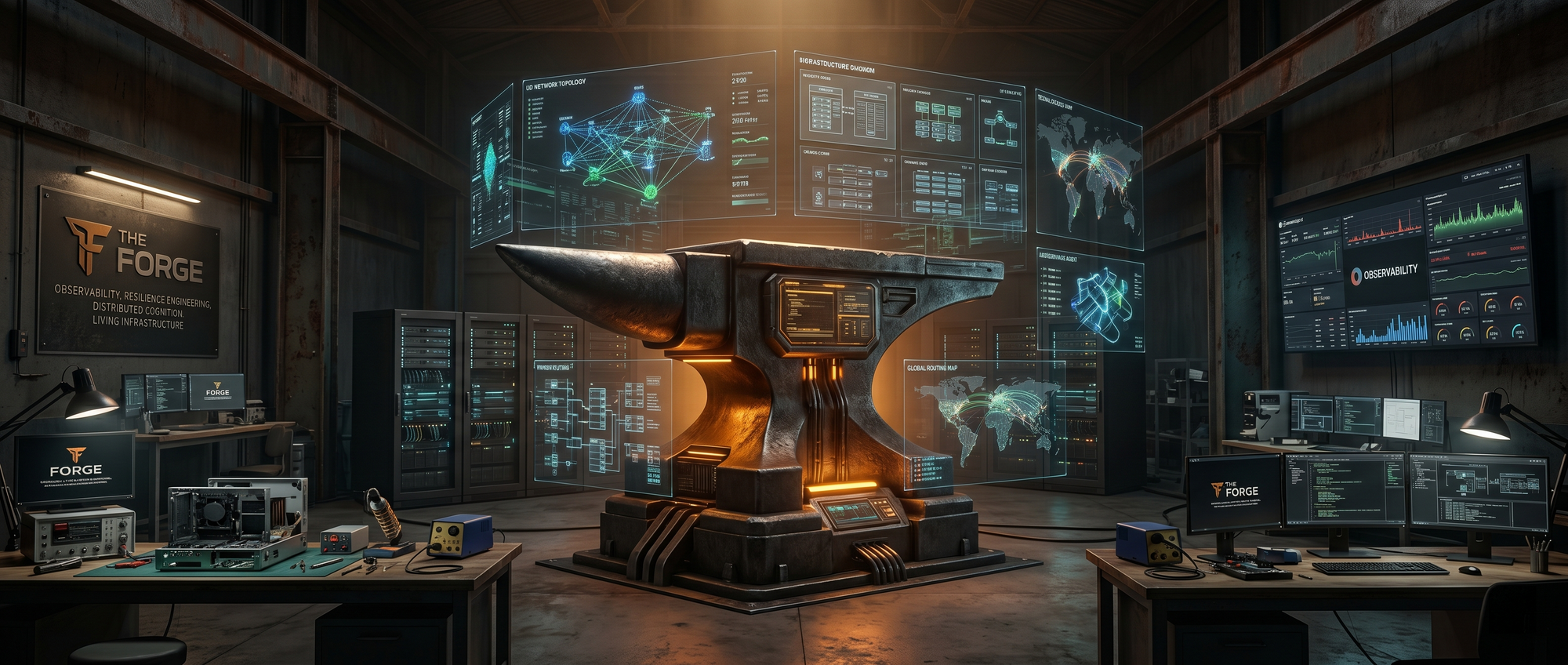
The Forge
The Forge serves as the operational heart of the laboratory.
It is not merely a project.
It is the environment through which all other projects are observed, monitored, tested, and refined.
The Forge represents the convergence of:
- Sovereign Intelligence
- Observable Systems
- Resilience Engineering
- Ambient Operations
- Distributed Cognition
As the laboratory evolves, The Forge becomes the interface through which the laboratory studies itself.
Long-Term Vision
Harvey Labs is building toward a practical understanding of autonomous infrastructure.
The objective is to create environments that are:
- Observable
- Explainable
- Resilient
- Sovereign
- Adaptive
The work is not focused on replacing humans.
The work is focused on amplifying understanding.
Every benchmark.
Every visualization.
Every fault injection.
Every model.
Every experiment.
Contributes to a growing body of knowledge about how intelligent systems behave in the real world.