The Straight Lead Punch: Force, Structure, and Timing
The straight lead punch looks simple. One hand. One line. Direct. Simplicity without understanding is ignorance. What appears as a single motion is a chain of precise mechanical events, each one depending on the one before it.

The Straight Lead Punch: Force, Structure, and Timing
The straight lead looks simple. One hand. One line. Direct.
Simplicity without understanding is ignorance.
What appears as a single motion is a chain of precise mechanical events, each one depending on the one before it. Remove any link, mistime any element, and the chain does not merely weaken, it collapses. A practitioner who has never studied the mechanism will train the appearance of the technique. They will perfect a shape. That shape will never carry the structure it is supposed to carry.
The knot cannot be untangled by someone who cannot see the knot.
What It Is
This is not a boxing jab.
A jab borrows speed from a shoulder snap and returns without committing. It touches the target. The straight lead is a committed collision. It converts your entire mass into a projectile using the same mechanical principle as a fencer's lunge. The difference is not stylistic. It is structural. The power source is different, the chain is different, and the result is different.
Power does not live in the fist. It originates in the earth.
The Physics of a Collision
Two equations govern what happens when your fist meets a target.
Impulse and Momentum Transfer
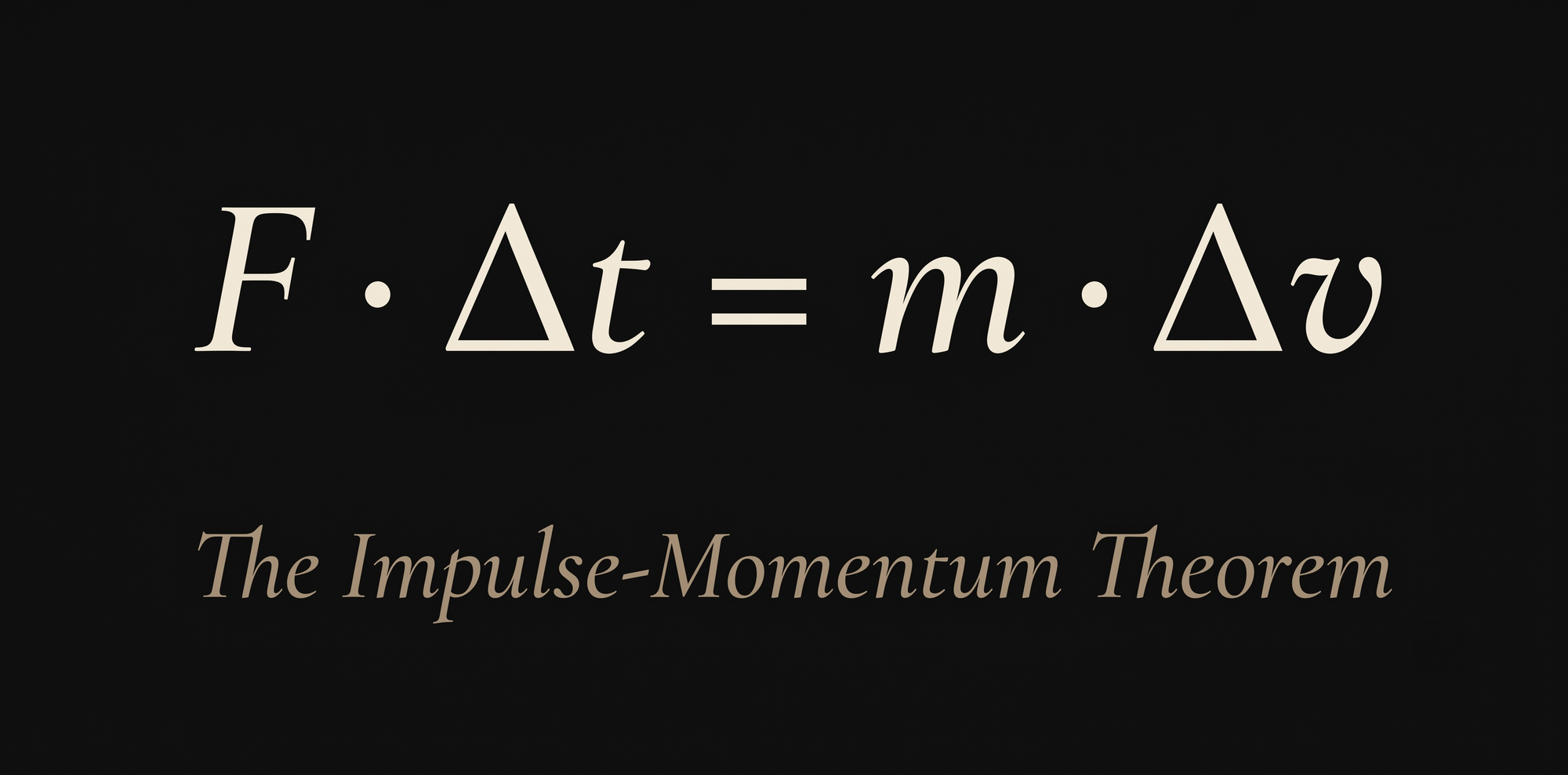
Combat physics focuses on impulse: the change in momentum over time.
$$\text{Impulse} = F \cdot \Delta t = m \cdot \Delta v$$
$$\text{F is Force.}$$
$$\Delta t \text{ is time of contact.}$$
$$\text{m is mass.}$$
$$\Delta v \text{ is change in velocity.}$$
Three variables increase the force transferred.
More mass behind the punch. Not just the arm. The entire body, aligned and moving.
Higher velocity at contact. Speed of the weapon at the moment of impact.
Shorter contact time. Snap the punch at the end via the body. Driving through the target extends contact time and bleeds force. A snap concentrates that same force into a shorter window, spiking peak impact. The snap also uses that collision impulse to initiate the recovery.
When you force a punch, you abandon structure. Muscle tension acts as a restrictor valve. It freezes the joints that must function as fluid conduits for the energy. You overextend. You create the interception angle your opponent needs. The straight lead does not increase force through effort. It removes resistance.
Kinetic Energy
$$KE = \frac{1}{2}mv^2$$
Velocity is squared. Doubling the speed of your attack quadruples its kinetic energy. This is why speed is prioritized over strength.
The straight lead does not force a choice between speed and mass. The mechanism increases both simultaneously.
The Biomechanical Mechanism: The Kinetic Chain
The straight lead is a sequential maximization of those equations. Every link in the chain either adds to the energy, passes it cleanly, or leaks it. There is no neutral. A joint that is not contributing is taking.
The Foundation: On-Guard Geometry
The stance is not neutral. It is pre-loaded with geometry.
The lead big toe aligns with the center of the oblique-turned rear foot, halfway between rear heel and rear ball. That line is the power line. The three contact points on the floor form a triangle: rear heel, rear ball of foot, lead big toe. The power line bisects it. Travel along that line and the kinetic chain is intact. Deviate and it isn't.
A second triangle runs from the bottom of the sternum, down through both legs, to the feet and into the ground. That triangle is the boundary of the center of gravity. At every point in the motion, the center of gravity must remain within it. When the rear foot fires and the lead foot lifts, the base reduces from two feet to one. The physics does not give you slack.
The arm is found, not forced. To find it, let the arm hang naturally at your side. Bring it forward to the power line. That is the position. The shoulder stays where it naturally sits. The fist strikes with the bottom three knuckles. The power arrives through the chain. In an actual attack the arm is a piston. It drives from its guard position straight to the point of impact and snaps at the end. The entire chain concentrates at that single point.
Link 1: The Trigger
The hand moves first.
This is tactical physics. If the body shifts before the hand moves, the shift is visible. The opponent reads the telegraph and the strike is finished before it arrives. Economy of motion is not a style. It is a structural requirement.
The lead hand fires. A fraction of a second later, the structure follows to back it up.
Link 2: Ground Initiation and the Stretch-Shortening Cycle
Physics begins at the rear foot.
In the straight lead stance, the rear heel is elevated. This is pre-loading. With the heel raised, the gastrocnemius and soleus are placed under eccentric load. The Achilles tendon and the plantar fascia store elastic potential energy as series elastic components, a loaded spring awaiting release. This is the eccentric phase of the stretch-shortening cycle.
The stretch-shortening cycle is the body's most efficient force production mechanism. An eccentric pre-load followed immediately by concentric contraction produces significantly more force than a purely concentric contraction from rest. The precise position of the rear heel is something you can feel. It is the point of maximum elastic potential energy immediately preceding the concentric release.
When the rear leg drives against the floor, two things happen simultaneously. Newton's Third Law produces a ground reaction force equal and opposite to the push: the earth pushes back. The stretch-shortening cycle releases its stored elastic energy into that drive. The result is high-force, high-velocity horizontal acceleration of the center of mass.
Link 3: The Three Energies and Curvilinear Flow
The straight lead requires the precise balance of three intersecting forces. An error in any one degrades the entire chain.
Horizontal Energy: The linear drive of the center of mass forward. This is the dominant vector.
Vertical Energy: The settling of body weight downward towards the floor as the fist lands. This is what makes the strike heavy at contact rather than skating across the surface.
Transverse Energy: The rotational torque generated across the core.
Within this architecture, every joint is a node. A node either amplifies force, passes it cleanly, or leaks it. The transverse energy crosses the body through the posterior oblique sling (the muscular system connecting the latissimus dorsi on one side diagonally to the gluteus maximus on the opposite side through the thoracolumbar fascia), sequentially activating the shoulder, the elbow, and the lead hand.
During this rotation the hips and the shoulders move as a single unit. They do not rotate independently. The core bracing is what locks them together. Without it, energy bleeds between hips and shoulders before it reaches the fist.
When all three energies are in correct balance, force travels in a curvilinear flow. An unbroken conduit from the rear foot to the point of impact.
The balance is precise. If horizontal momentum outpaces vertical root, structural integrity fails and foot drag occurs. If vertical energy dominates, the trajectory falls short and the footwork hops rather than penetrates. If transverse rotation exceeds the horizontal drive, the lead hand arcs laterally instead of traveling straight. Any imbalance immediately degrades both velocity and structural power.
Link 4: The Collision, Intra-Abdominal Pressure, and Effective Mass
The hand lands just before the lead foot. The sequence is 1-2-3: the lead hand lands, the lead foot lands, the rear foot comes back up to restore the original foot spacing. The stance returns to where it started. This is done with intention not laziness.
By making contact before the weight fully settles, forward momentum carries the strike into the target rather than dispersing into the ground.
The structure must become solid before impact.
The diaphragm contracts downward, the pelvic floor contracts upward, the transverse abdominis and multifidus co-contract circumferentially around the spine. This is multidimensional dynamic core bracing, a pressurized cylinder that converts the spine from a flexible, energy-dissipating column into a rigid structural pillar.
The brace must be initiated before the transverse phase, not at the moment of impact. The posterior oblique sling transfers rotational force against the core. If the core is soft during that transfer, force dissipates at the center of the chain. A pressurized cylinder means the rotational energy transfers without leakage. A braced core during the wave does not slow the wave. It amplifies it. Brace too late and the cylinder forms for nothing. The energy has already leaked. Brace too soon and you create drag.
This cannot be approximated by tensing the stomach. It is a coordinated, reflexive co-contraction trained through specific and deliberate practice, maintained while the body is in full dynamic motion. That is a different demand than bracing on a stable surface. It must be trained as such.
When this bracing is present and the kinetic chain is fully aligned, effective mass is engaged. In an unbraced, unaligned state, the structure breaks at its weakest links. With the chain aligned and the core cylinder pressurized, the entire moving mass of the body transfers into the target. You are not hitting with the fist. You are hitting with everything behind it.
A strike without mass is motion. Speed is the symptom of perfect timing meeting zero resistance.
Link 5: The Landing
How the lead foot lands after impact determines range, recovery, and what follows.
Long Range (The Fencer): The foot lands heel first, rolling forward. This maximizes forward travel and structural penetration. Recovery is slower but penetration and range is greater.
Short Range (The Brakes): The lead foot lands on the ball. Forward momentum stops immediately. This is precision stopping for no-man's-land, where continuous forward commitment creates exposure. The instant halt allows immediate direction change. It’s a trade-off, shorter range but faster direction change.
The choice is dictated by distance at contact and what must come next.
The Development
Understanding the mechanism does not mean you have the technique.
The correct neurological firing order must become automatic. This cannot be rushed. The nervous system requires deliberate repetition, progressive load, and time. Under pressure, the pattern you encoded is the pattern you get.
Core bracing under dynamic motion is a different skill from bracing on a stable surface. Generating intra-abdominal pressure reflexively while the body is in full flight must be trained as such.
Compensations accumulated over years of life and prior training surface exactly where precision is required. The technique finds every one of them.
Then there is the time. Hours upon hours. Years upon years.
The process is not complex. It is daily progress, self-honesty, and the removal of everything that does not belong. You untangle the knot. You do not cut it. Cutting it is faster, and the result is not what you came for.
When the technique arrives, it flows. One hand. One line. Direct.
That simplicity was earned.
There is no shortcut through the knot.
The technique is correct. It has always been correct. It works when the body stops interfering with the physics. Every hour in the studio, every correction, every repetition is not complexity being added. It is interference being removed.
The jab asks the arm to be fast.
The straight lead asks everything to be correct.
When everything is correct, speed is the proof.
Understanding does not replace repetition.
Go train.
Part 2 of this series traces the same biomechanical signature across ten martial traditions spanning twenty-five centuries.
The Jab vs. The Straight Lead
| Feature | Static Boxing Jab | The Straight Lead |
|---|---|---|
| Dominant Force | Rotational Torque | Convergence of Three Energies |
| The Trigger | Weight shift or shoulder rotation | The hand moves first |
| Ground Mechanics | Rotational push | Stretch-shortening cycle, massive linear drive |
| Energy Transfer | Core rotation | Posterior oblique sling and curvilinear flow |
| Impact Timing | Step and hit simultaneously | Hand lands just before the lead foot |
| Core at Impact | Partial bracing | Intra-abdominal pressure, full structural rigidity |
| Effective Mass | Arm plus partial core shift | Full body mass at contact |
| Resulting Speed | Forced muscular velocity | Perfect timing meeting zero resistance |
If this kind of work is useful to you, subscribe.
One email when something new publishes. No noise.