The Uncarved Block
Amy had that look. I am the measured one. I plan, I sequence, I assess before I move. She sees a Facebook Marketplace post about a pile of cut trees on a Saturday night, television on, evening settled, and she gets that look.

From the Workbench
Amy had that look.
I am the measured one. I plan, I sequence, I assess before I move. She sees a Facebook Marketplace post about a pile of cut trees on a Saturday night, television on, evening settled, and she gets that look.
I grinned.
Not because I had a plan. Because I recognized the signal.
Thirty minutes later we were loading juniper into the truck from a stranger's yard. No blueprint. No design. Just wood that used to be trees and a wife who knew something I didn't yet.
Back in the shop I didn't start cutting immediately.
I looked.
In Taoism there is a concept called pu. The uncarved block. The idea that everything already contains its essential nature before human hands touch it. The task is not to impose form. The task is to uncover what was already present before you arrived.
That juniper had lived a whole life before I met it. The twist in the grain. The knots where branches once reached toward light. The purple heartwood that only reveals itself when you cut deep enough. None of that was mine to create.
It was my task to uncover.
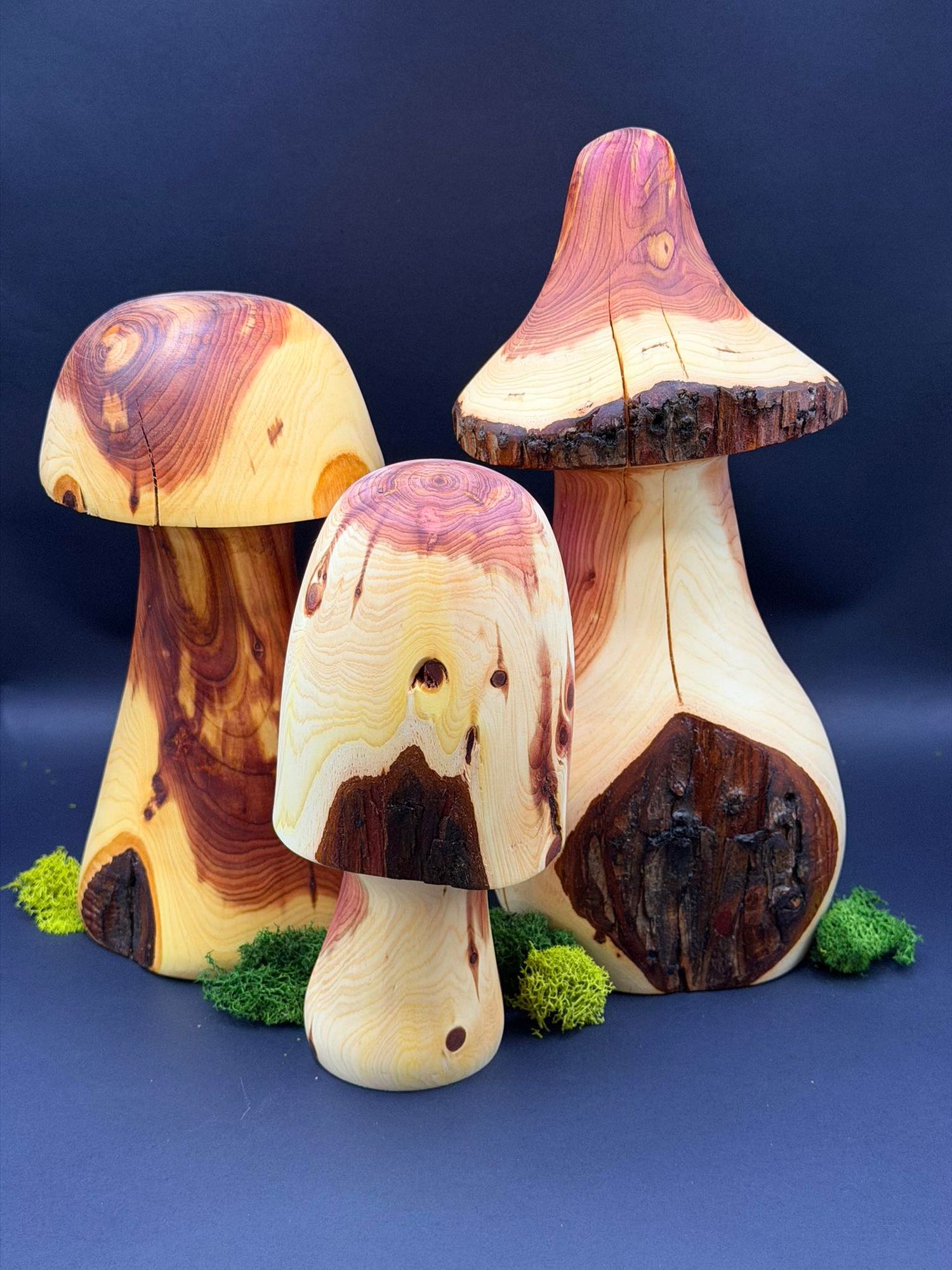
I saw mushrooms. Three of them, inside the same log. I cannot explain that with more precision. There are states that woodturners, martial artists, musicians, and engineers sometimes enter where conscious decision-making goes quiet and perception becomes unusually clear. The Japanese call it mushin. The Greeks approached it with a word, ataraxia, that has been translated poorly for centuries. The Norse understood it as something that moves through the willing craftsman rather than originating in him.
I have my own words for it depending on the day.
What I can tell you is that I did not design those mushrooms. They were already there. I was simply the last thing that needed to happen.
The rough turning was straightforward. Then the wood did what wood does.
It moved. It breathed. It cracked.
This is where the impulse toward control becomes dangerous. I had options. Epoxy. Coffee grounds. Walnut shell. All of them would have resolved the cracks technically.
But I had learned something from Amy's look on a Saturday night.
Sometimes the answer is not yours to make alone.
I posted a photo of the cracked first mushroom to our community and asked them what they saw. Not what I should do. What they saw. That distinction matters more than it might appear. One question invites expertise. The other invites perception. I wanted to know what the wood was still trying to say, and I couldn't be the only one listening.
They voted. I followed their direction on the remaining two.
The cracks stayed. The bark stayed. The life the tree had lived stayed.
I think about that Saturday night.
A measured man. An impulsive wife. A stranger's pile of cut trees. A cracked blank at the critical moment. A community that finished what the tree started.
None of it was in the plan because there was no plan. There was only the signal, and the willingness to follow it out of a warm bed on a Saturday night.
The muse does not wait for convenient timing. It does not care about your schedule or your comfort. It arrives through the people around you, through the grain of wood you didn't know you needed, through cracks that appear at exactly the moment you think you know what you're doing.
Your task is not to create.
Your task is to be available.
More from the workbench when it arrives.