INSTALLMENT TWO: THE WORKSHOP
A documented journey in building autonomous intelligence from the ground up, written for the THT community who asked to understand AI from the inside out. No computer science degree required. Just curiosity and a willingness to travel.

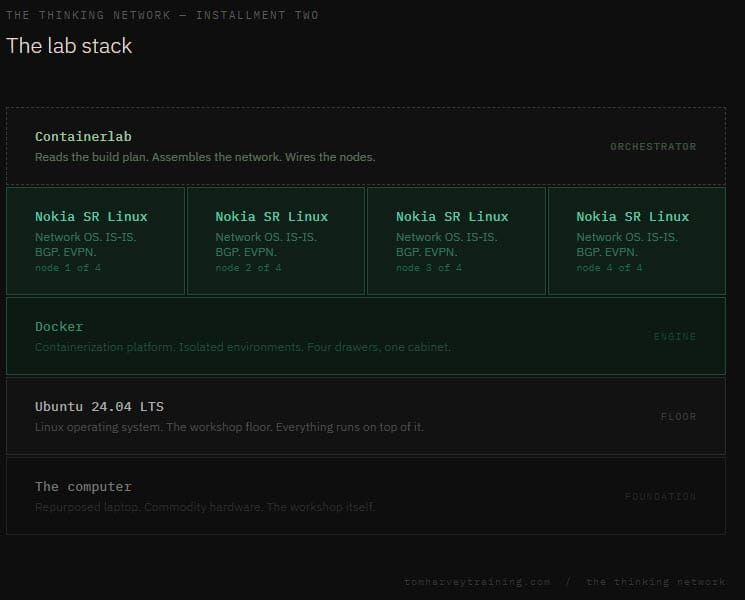
We are not ready to build yet. That is not impatience. That is craft.
THE THINKING NETWORK: A documented journey in building autonomous intelligence from the ground up, written for the THT community who asked to understand AI from the inside out. No computer science degree required. Just curiosity and a willingness to travel.
Before we touch a single command, before the first router boots and the first packet moves, we need to walk the space.
Every craftsman does this. You don't sit down at a new bench and start cutting. You look at what's there. You learn where the tools live. You understand what each one does and how they relate to each other before the work begins.
This installment is that walk. No commands yet. Just the space, the tools, and the relationships between them.
Before we go deeper, five tools. Each one doing one job.
- The Computer: The physical machine everything runs on.
- Ubuntu 24.04 LTS: The operating system. The floor of the workshop.
- Docker: The containerization platform. The tool cabinet.
- Nokia SR Linux: The network operating system. The router.
- Containerlab: The orchestration layer. The build plan.
By the end of this installment, you will know what each tool is, what it does, and why it sits where it sits in the stack.
THE BENCH
The computer is the workshop. In this case, a repurposed laptop. Commodity hardware, nothing exotic. The kind of machine that has already lived one life and is being asked to become something else.
The operating system is Ubuntu 24.04 LTS. Ubuntu is a distribution of Linux, the open-source operating system that runs underneath most of the world's serious infrastructure. Banks. Hospitals. Carrier networks. The internet itself. When you interact with almost any large-scale technology system, Linux is somewhere in the stack.
Think of Ubuntu as the workshop floor. It organizes the space. It manages the tools. It makes sure everything has somewhere to live and something to run on. You don't think about the floor until something is wrong with it. When it's right, you just work.
This is the physical ground. Everything else we build lives on top of it.
THE TOOL CABINET
Docker runs on top of Ubuntu. It is a containerization platform.
Here is what that means in practice: A container is an isolated software environment running inside the host machine. It has its own filesystem, its own processes, its own network interfaces. It behaves as if it is a completely separate computer. But it shares the underlying kernel with the host and with every other container running alongside it.
The workshop equivalent is a tool cabinet with deep, isolated drawers.
Each drawer holds everything needed for one specific job. The tools in drawer one don't mix with the tools in drawer two. You open the drawer, the environment is exactly as you configured it, and you work.
Close it, and nothing bleeds into anything else.
This is how we run four routers simultaneously on one laptop. Each router lives in its own container. Isolated. Consistent. Repeatable. Docker is what makes that possible.
THE SPECIALIZED EQUIPMENT
Nokia SR Linux is the router.
More precisely, it is a network operating system—the software intelligence that makes a router behave like a router. IS-IS. BGP. EVPN. These are the protocols that move traffic across real carrier networks, the same networks that carry your phone calls, your streaming video, your financial transactions. Nokia SR Linux runs these protocols on physical hardware that costs more than most people's cars. Or homes, in some cases.
It also runs inside a Docker container on a laptop.
That is not a compromise version. It is the same software Nokia ships on physical carrier hardware, running here in software with full protocol fidelity. The container is the drawer. SR Linux is the precision equipment inside it.
This is what we mean by a digital twin. Not a simulation. Not an approximation. The real thing, running in a different form.
On the mat, the equivalent is working with a training partner who has genuinely high-level skills. The environment is controlled. The contact is real. What you learn transfers directly to any other environment where those same skills appear.
THE BUILD PLAN
Containerlab is the orchestration layer that sits on top of Docker.
Where Docker creates and manages individual containers, Containerlab understands network topology. It reads a YAML file—a plain text configuration document—and from that single file builds an entire network environment. Which containers to create. Which Nokia SR Linux image to run inside each one. How to wire the virtual Ethernet interfaces between nodes. What management addresses to assign.
The whole fabric assembled from a document.
In the workshop, this is the build plan pinned above the bench. The detailed drawing that shows not just what each component is, but how every piece connects to every other piece. You follow the plan. The workshop comes alive.
In this lab, the plan is called lab.yml. Thirty lines of text. Four routers. A diamond topology. We will look at it closely in the next installment.
THE RELATIONSHIP
Before we move on, here is the full picture in one place:
- Ubuntu is the workshop floor. The physical ground.
- Docker is the tool cabinet. Isolated, standardized environments.
- Nokia SR Linux is the specialized equipment. Carrier-grade protocol fidelity.
- Containerlab is the build plan. The automated hand that assembles it.
- The Computer is the workshop itself.
None of these is metaphor. Each one is a real tool with a real name that you will see again throughout this series. The engineer reading this is already familiar with all of them. The practitioner reading this now has the frame they need to follow everything that comes next.
THE SHADOW WORK
There is one more thing worth naming before we move on.
What we are building is a digital twin. A network that exists entirely in software but behaves, for research purposes, exactly like real carrier-grade infrastructure. The same protocols. The same failure modes. The same behaviors under pressure.
This is how serious network research happens outside of vendor labs and university budgets. You reconstruct the environment in software with enough fidelity that what you learn transfers to the real thing.
In training, the equivalent is shadow work. Forms practice.
It is the movement done without a partner that still builds the pattern into the body. It isn't live training. It isn't meant to be. It is the environment where you slow down, examine, repeat, and understand what you are actually doing before speed and pressure make examination impossible.
The lab is shadow work for autonomous network intelligence.
Next installment: Before the First Command. What it actually takes to begin, and why the first obstacle was a thumb drive.